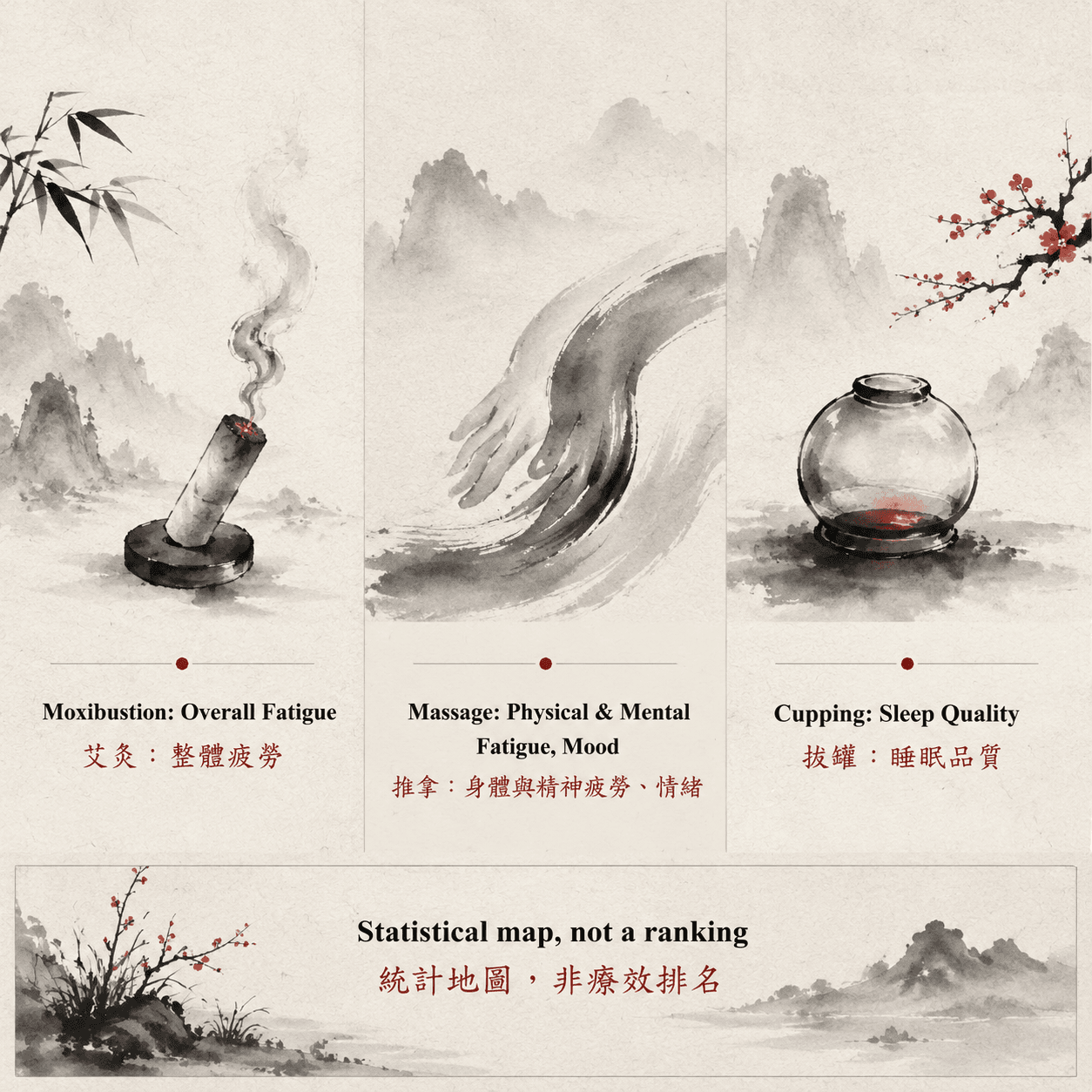
Faced with these statistical differences, we might wonder: why do moxibustion, massage, and cupping show different strengths of association with different symptoms? The modern research itself does not provide a definitive physiological mechanism to explain this, but we can find a conceptual thread for understanding this therapy "toolkit" within classical Chinese medicine theory.
The Huangdi Neijing: Lingshu contains a classic description of the sleep mechanism: "夫衛氣者,晝日常行於陽,夜行於陰,故陽氣盡則臥,陰氣盡則寤。" This says that the body has a type of energy called "wei qi" (defensive qi). During the day, it travels in the yang division of the body (the exterior, the channels), keeping us awake and active; at night, it enters the yin division (the interior, the organs), allowing us to sleep peacefully. When this rhythm is disrupted, problems arise, as another passage states: "衛氣不得入於陰,常留於陽……故目不瞑矣。" This means that if the wei qi cannot smoothly enter the yin division at night and remains stuck in the yang division, it leads to an excess of yang and a deficiency of yin, resulting in insomnia.
From this perspective, the warming power of moxibustion, which is adept at warming and unblocking the channels and supplementing yang qi, might help adjust the fundamental dynamic of "wei qi circulation," thereby having an impact on the overall feeling of fatigue. Massage, through manual techniques that directly act on the muscles, fascia, and channels, can not only relax the physical form but also regulate the qi dynamic, which might explain why associations were observed across physical and mental fatigue, and even emotional dimensions. As for cupping, its application of negative pressure to the body's surface is thought in Chinese medicine to dispel pathogenic factors like "wind, cold, and dampness" from the exterior. If sleep problems are related to a state where wei qi is "stuck in the yang" and cannot smoothly enter the yin, then clearing blockages at the surface might create the conditions for the wei qi to return to the interior at night.
Furthermore, the Lingshu also points to another source of fatigue: "憂思傷心……忿怒傷肝……用力過度,若入房汗出浴,則傷腎。" This reminds us that long-term emotional stress and physical overexertion can, at a deep level, deplete the essential qi of the organs. This may also help us understand why a complex fatigue problem might require different tools from a toolkit, seeking adjustment from different levels.
Editorial explanation for everyday understanding; this paragraph is not presented as a finding from the cited study.