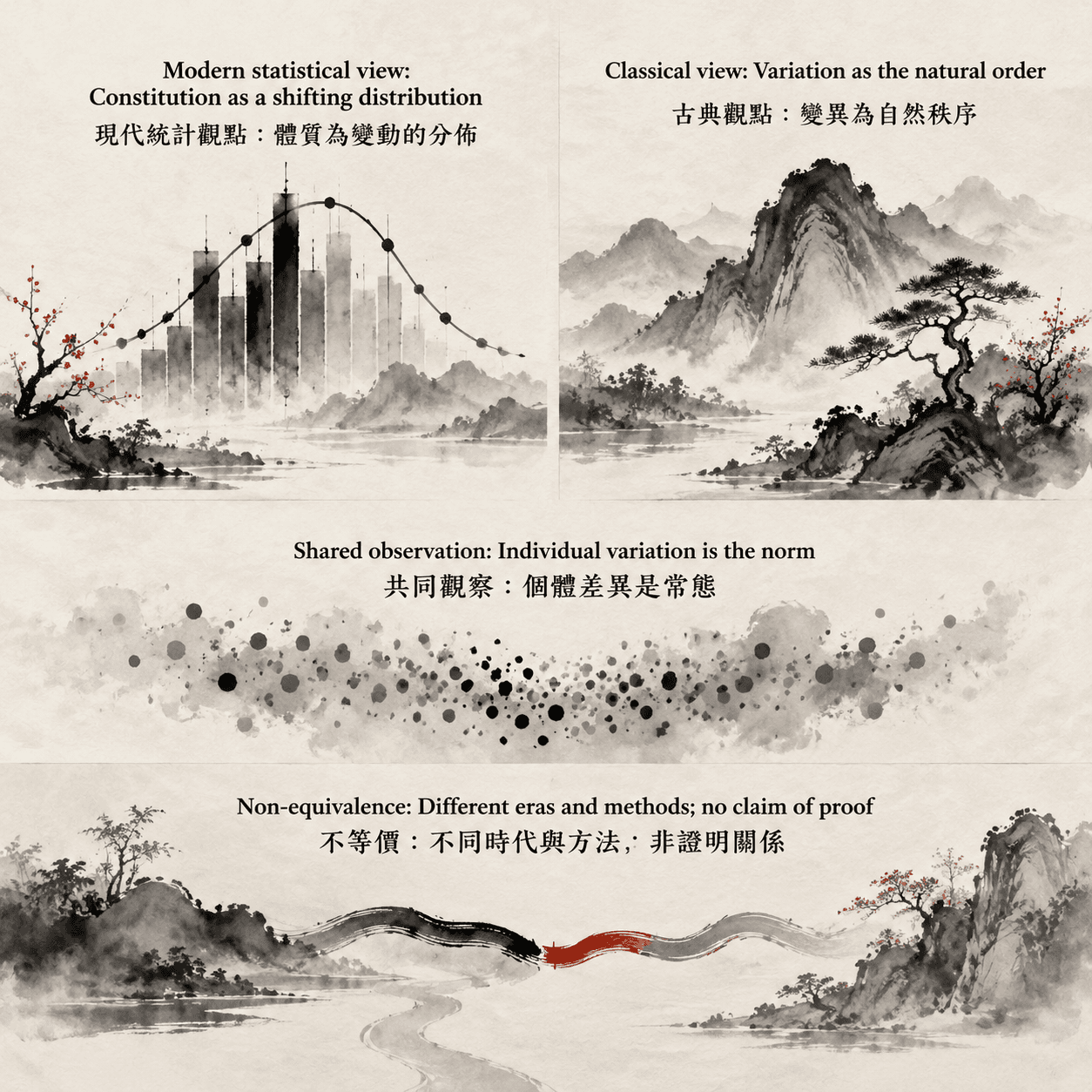
If body constitution is best understood as a long-term tendency that traditional Chinese medicine uses to describe how a person tends to feel, respond, and adjust, then a large community survey functions less like a diagnostic tool and more like a map drawn from above. The Hangzhou study, published on 2025-11-28, asked a simple but unusual question: when you look at thousands of adults at once, what does the landscape of constitution actually look like, and does it shift by age, sex, or body weight?
The team used the 2016 version of the Constitution in Chinese Medicine Questionnaire, a standardized 54-item instrument that sorts respondents into nine constitution categories. One category, called Balanced, is meant to capture a relatively coordinated state; the remaining eight are considered unbalanced types, named Qi Deficiency, Yang Deficiency, Yin Deficiency, Phlegm Dampness, Damp Heat, Blood Stasis, Qi Stagnation, and Special. The questionnaire is also designed to register tendencies that fall just short of a full classification, so the same person can carry several labels at once.
The headline number is this: among 8,665 adults aged 18 to 80, the Balanced constitution was the most common single type at 22.3%, yet well below half the sample. Among the eight unbalanced types, Qi Deficiency led at 16.4%, followed by Phlegm Dampness at 11.0% and Yang Deficiency at 9.4%. A combined 74.2% of participants fell into at least one full constitution category, while the remaining 25.8% registered only tendencies below the formal threshold. Most strikingly, over half of those with an unbalanced constitution carried additional constitutions at the same time, producing the composite patterns the study highlights: Qi Stagnation paired with Qi Deficiency, Blood Stasis with Qi Deficiency, and Damp Heat with Phlegm Dampness.
Zooming in, the map tilts in recognizable ways. Younger adults aged 18 to 39 were classified as Balanced only 13.1% of the time and more often displayed composite unbalanced patterns. Men clustered toward Phlegm Dampness and Damp Heat, while women clustered toward Yang Deficiency and Yin Deficiency. After adjusting for age and sex, individuals with obesity showed a higher prevalence of Phlegm Dampness and a lower prevalence of Balanced, Yang Deficiency, and Yin Deficiency types. These shifts are statistical associations, not causal claims, and the figures describe one Chinese city rather than a universal rule, so they should be read as a snapshot of a population rather than a verdict on any individual.
Editorial explanation for everyday understanding; this paragraph is not presented as a finding from the cited study.