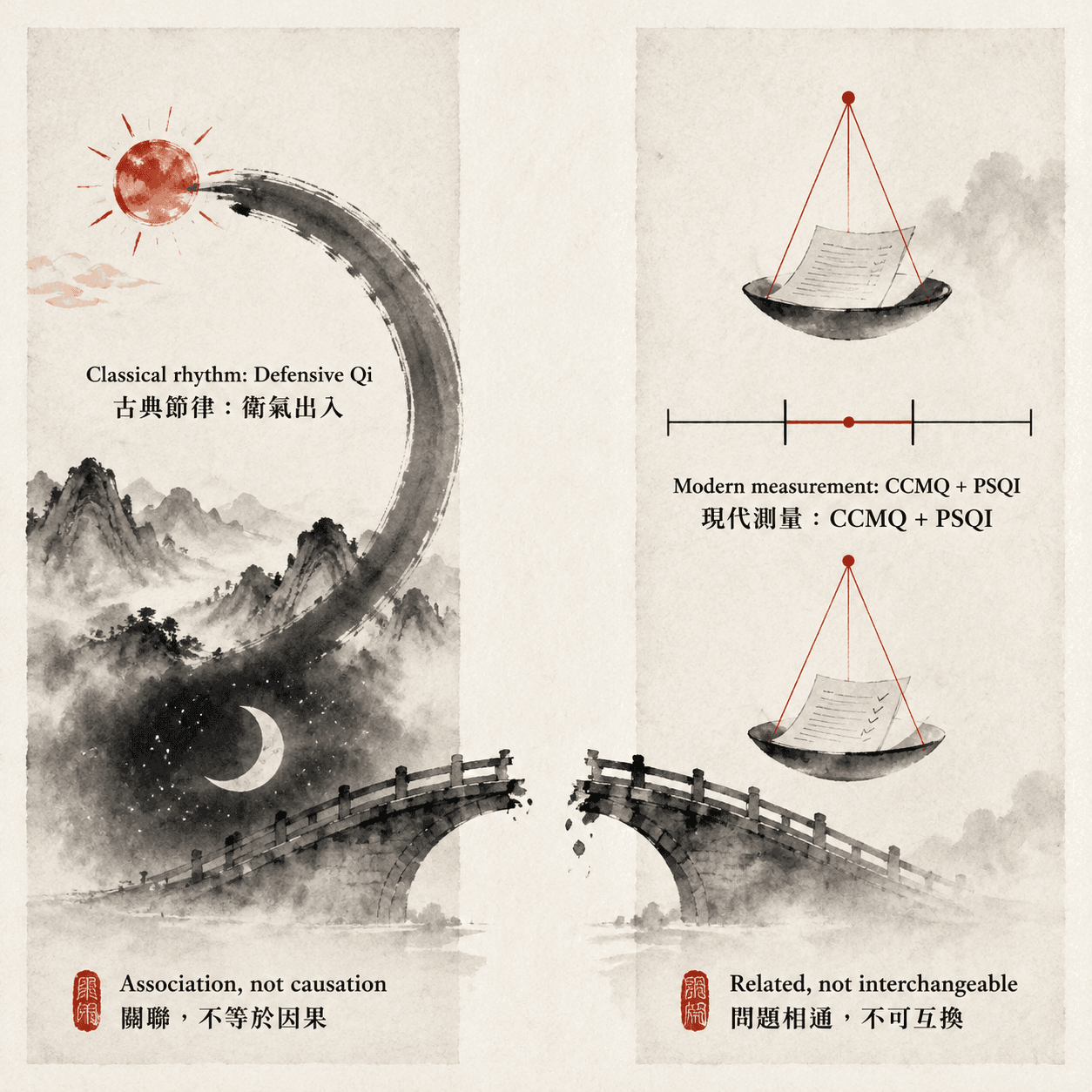
When the Lingshu discusses sleep, it uses the classical language of defensive qi moving into yin and out toward yang. One passage says that when defensive qi cannot enter yin and remains in yang, the eyes do not close. Another describes defensive qi as moving in yang by day and in yin at night, placing sleep and waking within a complete alternation of activity and rest. The classical question is therefore not limited to a score recorded at bedtime; it asks how a person passes from daytime engagement into nighttime repose.
The modern study asks something methodologically different: which categories in CCMQ and PSQI responses were statistically associated among a group of crew members. The two can be read together because both direct attention toward human variation and the transition between activity and rest. They are not interchangeable. Defensive qi and yin-yang movement are concepts within a classical theoretical system; questionnaire scores, odds ratios, and confidence intervals belong to modern measurement and statistics. The study did not test the classical model, and the classical model cannot explain the study's numerical association.
The Lingshu also describes different human dispositions, showing that classical writers took individual variation seriously. But those dispositions are not the same classification as modern CCMQ categories. A rigorous bridge does not match terms merely because they sound familiar. It preserves the historical purpose and method of each system.
TianJi's contribution here is a reading sequence, not a claim that the paper proves the classic: establish what the study measured, examine how the classical text framed rhythm and variation, and keep the distance between them visible. That distance is what separates a meaningful comparison from forced correspondence.