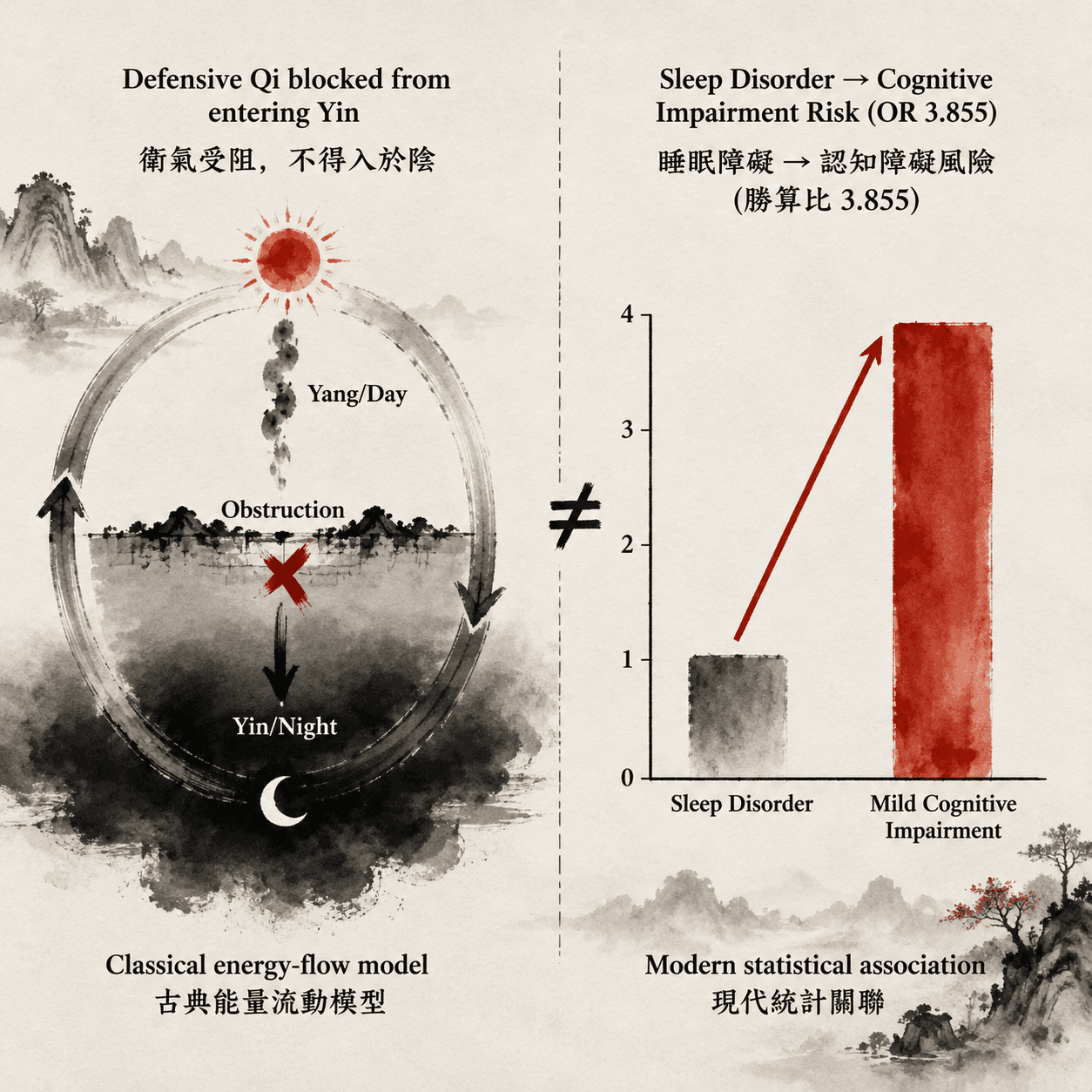
When modern research clearly links the cold statistical figure of "sleep disorders" to the risk of cognitive decline, it also knocks on a door leading to ancient wisdom. The strong association found in the study makes us ask: what exactly happens in the body between sleep and wakefulness?
The Huangdi Neijing·Lingshu offers a highly poetic explanation. It describes a type of energy in the human body called "defensive qi." This qi, as stated in the text, "travels in the yang during the day and in the yin at night," and its rhythm of movement determines our sleep and wakefulness. During the day, defensive qi travels in the body's more superficial, yang-affiliated channels, making us energetic; at night, it dives into the deep, yin-affiliated organs, allowing us to sleep peacefully. The text further pinpoints the key to insomnia: "When the defensive qi cannot enter the yin and constantly remains in the yang… therefore the eyes cannot close." When this qi, which should hide in the yin at night, is stuck in the yang phase and cannot transition smoothly, a person's thoughts will race, making it difficult to close their eyes.
The statistical association from this modern study and the description from the ancient classic resonate in a curious way here. The "sleep disorder" risk found in the study can be understood, in the context of the classic, as a blockage in the process of "defensive qi entering the yin," causing the body's yin-yang transition to lose its proper rhythm. As for the "marrow-deficiency" mentioned in the study, in TCM theory, the brain is the "sea of marrow," the gathering place of life's refined essence, and is closely related to the generation and nourishment of defensive qi. When the sea of marrow is empty, not only are thoughts unclear, but the body's very foundation is shaken, making it naturally difficult to maintain the rhythm of sleep. Similarly, the two body states of "phlegm-turbidity" and "internal-heat" are like obstacles on a path and unnecessary heat; they obstruct the smooth movement of defensive qi, preventing it from returning to the yin phase at night, thereby disturbing the natural cycle of sleep and wakefulness. This study serves as a modern data footnote for an ancient theory, reminding us that sleep is not just rest but a vital manifestation of whether the body's energy pattern can successfully complete its yin-yang transition.
Editorial explanation for everyday understanding; this paragraph is not presented as a finding from the cited study.