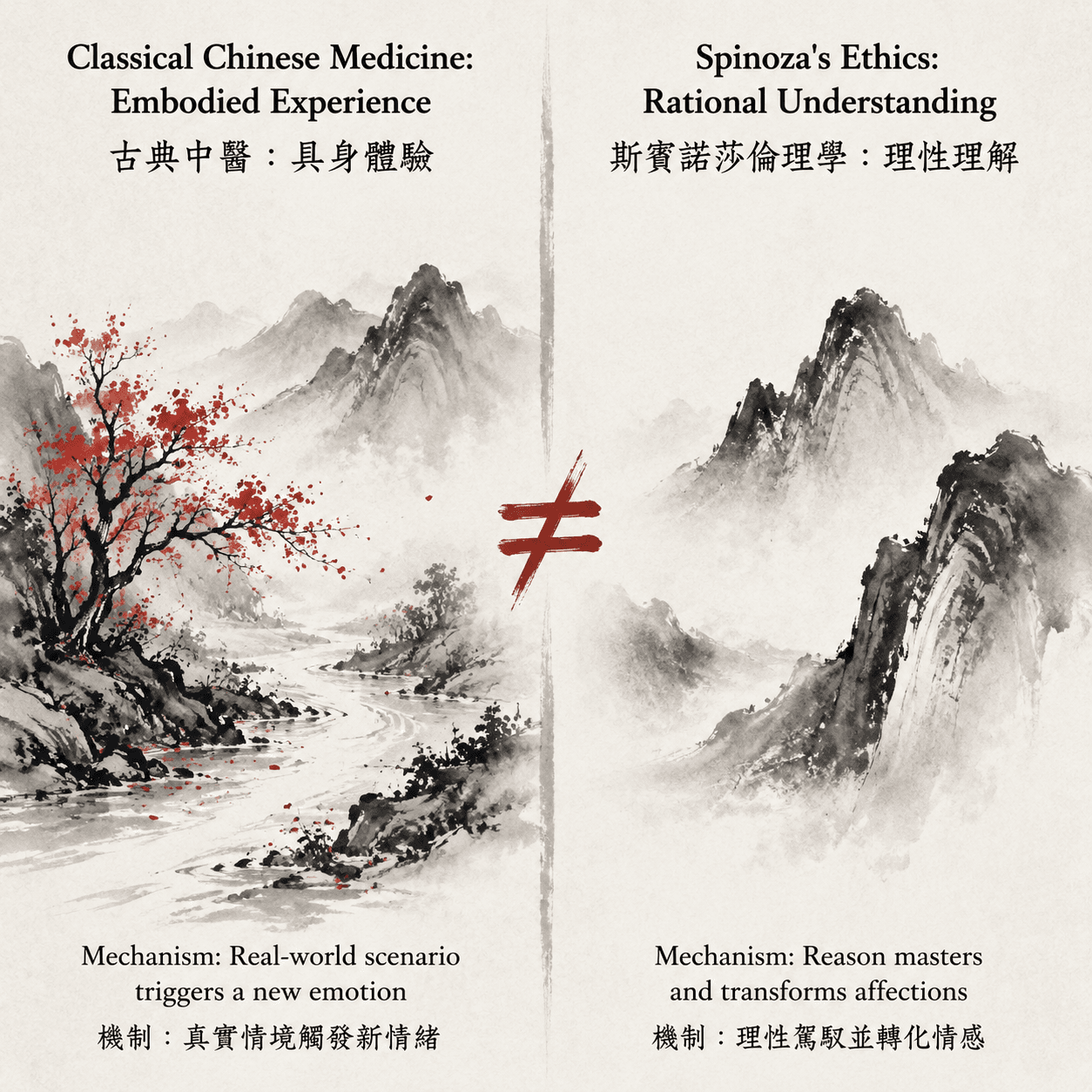
To put it in plain terms, the classical Chinese medical concept of 'overcoming one emotion with another' is built on a premise: emotion is not just a thought in the brain but a holistic state intertwined with the body's qi, blood, and organ activities. Precisely because emotion is a 'whole-body' phenomenon, transforming it often requires another equally 'whole-body' intense experience, not just verbal persuasion. This is why physicians in ancient medical cases would go to great lengths to arrange a real scenario, ensuring the person's emotions were 'genuinely stirred.'
Here, we can refer to a passage from the *Huangdi Neijing·Lingshu* (The Spiritual Pivot). It states: 'Excessive worry and pensiveness injure the heart; severe cold injures the lung; fury and anger injure the liver; drinking alcohol and then engaging in sexual activity, or sweating and then being exposed to wind, injures the spleen; excessive exertion, or engaging in sexual activity when sweating and then bathing, injures the kidney.' This passage is not about the specific practice of 'overcoming emotion with emotion,' but it clearly demonstrates how classical Chinese medicine views the relationship between emotions and the body: excessive worry injures the heart, excessive fury injures the liver. There is a correspondence between emotions and organs as described by classical theory. It is precisely because emotions are seen as holistic forces capable of 'injuring' specific organs that physicians, when considering how to resolve an excessive emotion, would think of using another emotion to counteract it, in order to restore what classical theory calls balance. It must be emphasized again that this classical 'injury to the liver' or 'injury to the heart' is a concept within traditional theoretical language and cannot be directly equated with a modern medical diagnosis of organic disease in the liver or heart.
As for why 'trust' and 'cooperation with a close person' are so important, this can be understood from another angle. Another sentence in the *Huangdi Neijing·Lingshu* discusses the origins of disease: 'The origin of all diseases arises from wind, rain, cold, and summer heat; from the yin and yang of joy and anger; from diet and dwelling; and from great fright and sudden fear.' Here, 'the yin and yang of joy and anger' and 'great fright and sudden fear' are listed together as factors in the genesis of disease, showing that in the classical Chinese medical view, a person's life circumstances and emotions are a common source of both health and illness. Since emotions are deeply embedded in a person's life situation, transforming them naturally requires mobilizing real people and real relationships within that life situation, not just a dialogue between the physician and the person in a consultation room. This is why ancient medical cases regard 'family cooperation' or 'the patient's complete trust in the physician' as a prerequisite for the treatment to begin.
Compared to Spinoza, the most distinctive feature of this framework is that it does not require the person to first use reason to 'see through' their emotion. Instead, it allows for, and even deliberately arranges, another emotion to override the original one. This might sound counterintuitive to a modern reader—we are often taught to 'be aware of' and 'accept' our emotions—but within the classical Chinese medical framework, emotion is inherently a flowing, holistic phenomenon. Using another powerful emotion to break through it is not suppression but a way for the whole system to regain balance. This is exactly what the paper means when it says there is 'more variability than commonality' between the two.
Editorial explanation for everyday understanding; this paragraph is not presented as a finding from the cited study.